
Derivative-Free Optimization Drives Advances in AI and Engineering Systems
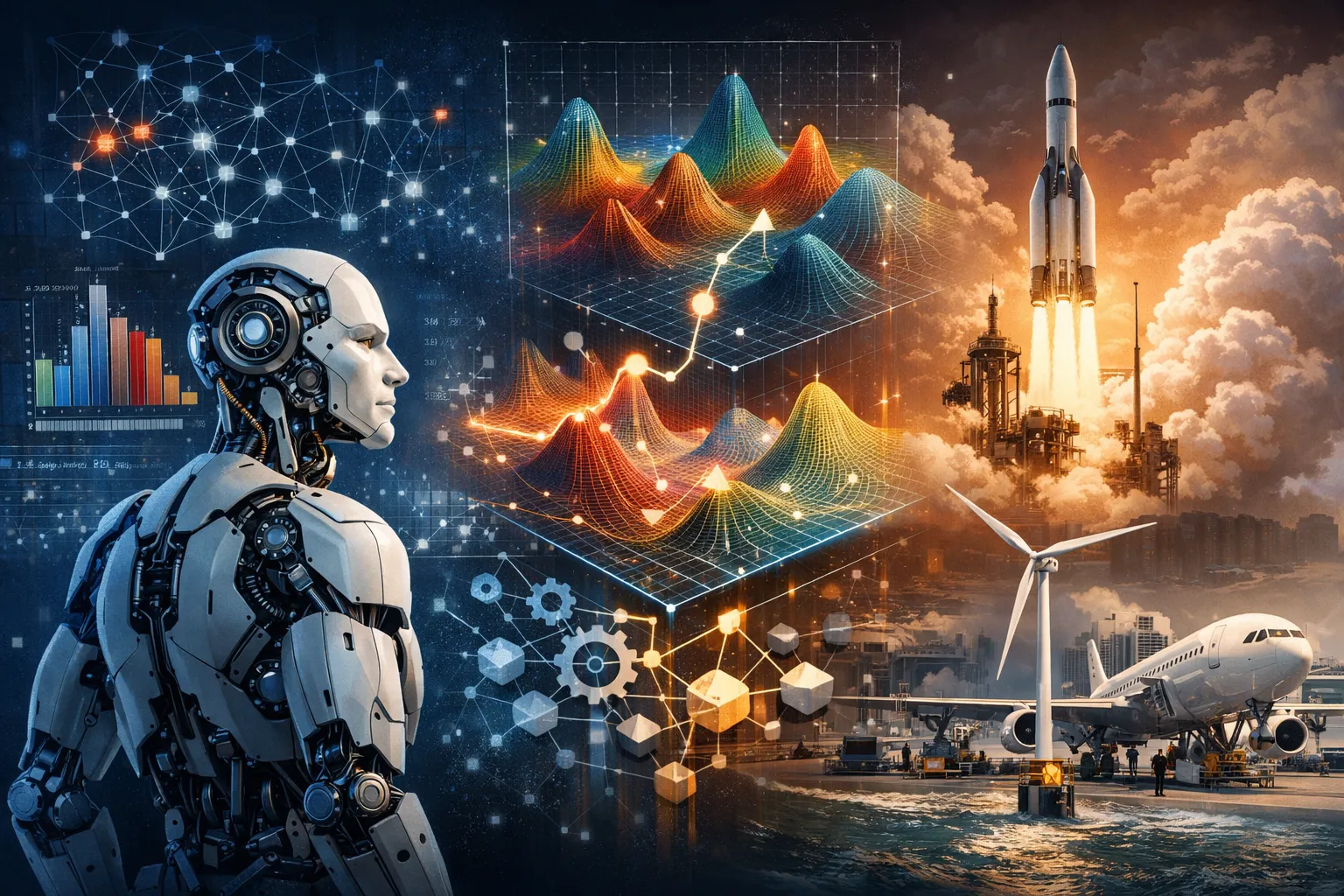
Derivative-free optimization (DFO) techniques are transforming frontier artificial intelligence and complex engineering systems by optimizing functions without relying on traditional derivative information. Unlike classical gradient-based methods, DFO operates effectively in scenarios where system internals are unknown or non-differentiable, using only function evaluations.
DFO methods include gradient-free exploration—such as direct search and trust-region surrogate modeling—and zeroth-order optimization, which numerically estimates gradients from function values. Bayesian optimization, a probabilistic surrogate-based approach, excels in costly evaluation contexts by balancing exploration and exploitation.
In artificial intelligence, DFO plays a vital role in training and fine-tuning large language models with billions of parameters, where backpropagation demands prohibitive memory and computation. Techniques like MeZO estimate gradients through forward evaluations alone, reducing memory use by up to twelve times and enabling fine-tuning on limited hardware. Multi-fidelity Bayesian hyperparameter optimization frameworks further enhance efficiency by early terminating unpromising configurations.
Engineering applications include calibrating complex electrochemical battery models, managing real-time power grid operations under uncertainty, and optimizing brain-computer interfaces and adaptive neuromodulation therapies amid noise and safety constraints.
Despite demonstrated successes, DFO faces challenges including computational inefficiency in high-dimensional settings, noise robustness, constraint handling, and integration of discrete variables. Ongoing research focuses on adaptive, noise-aware, and hybrid algorithms leveraging parallel computing to overcome these hurdles.
By decoupling optimization from explicit analytical models, derivative-free optimization provides a foundational framework enabling advancements across AI and engineering domains facing complex, black-box, and non-differentiable problems. https://bioengineer.org/derivative-free-optimization-bridges-frontier-artificial-intelligence-and-complex-engineering-systems/